


1. Why Winter Changes Calf Nutritional Requirements
As we approach winter and the air temperature drops, calf energy will be directed away from growth, health and development towards keeping the animal warm (1). As a result, unless nutrition is matched for this deficit, economic losses can result from calf mortality and morbidity and long-term effects on performance (2).
Calves can regulate their temperature to some extent (3, 4) but are prone to heat loss due to their small size (2). This is true even for Wagyu calves which are adapted to the cold winters of Japan.
Difficult births present a greater risk with less resistant calves (2) however movement, substantial colostrum and dry bedding enables healthy calves to withstand low temperatures surprisingly well.
Further challenges are present for UK Wagyu beef farmers who rely on dairy/beef crosses for their enterprises. In some of these systems calves receive less milk and colostrum and are weaned earlier than beef calves (5). Depending on the system, calves are also exposed to transportation stress as they are moved from production farms to rearer farms. These stresses in addition to the cold mean that rations that worked in mild weather may not maintain target growth in cold weather.
2. Recognising Cold Stress in Young Calves
Calves’ experience of cold depends not only on air temperature but also on air speed and moisture levels (1). Wet coats and bedding increase heat loss, while poor ventilation can lead to damp housing conditions.
Calves’ thermal comfort zones range from 6-15oC depending on age (adapted from AHDB).

Lower critical temperature (°C) of calves at different air speeds (adapted from AHDB).
| Age (weight) | Airspeed | |
| 0.2 m/s (draught-free) | 2.0 m/s | |
| Newborn (35 kg) | 9 oC | 17 oC |
| 1 month (50 kg) | 0 oC | 9 oC |
When temperatures fall outside the comfort zone, stress responses are triggered altering the calf’s respiratory rate, body temperature, hormone balance and metabolism (6). Spotting signs of cold stress early can minimise effects on performance and welfare.
Signs of cold stress include (7):
- Vigorous shivering which may become so severe it interferes with standing and suckling
- Increased breathing and heart rates
- Cold nostrils and pale, cold hooves
- Erratic behaviour, confusion, clumsy gait
Monitoring calf shed temperatures, supplying plenty of dry bedding material and eliminating draughts can reduce the likelihood of cold stress in calves (1). However, nutrition is a vital factor to ensure adequate energy supply when temperatures dip and feeding must be reviewed to account for this.
3. Adjusting Milk and Milk Replacer for Cold Weather
As calves grow so does their daily maintenance energy requirement. Nutritional advice for newborn and young calves in cold weather is as follows (1):
- Newborn to three weeks: Feed an extra 50 g/day of milk replacer, or 0.33 litres/day of whole milk, for each 5°C temperature drop below 15°C
- Three weeks+: Feed an extra 50 g of milk replacer, or 0.33 litres of whole milk, per day for each 5°C drop below 10°C
These are guidelines based on age and temperature not a universal feeding prescription.
As temperature drops, more milk is needed to maintain body temperature. For example, to achieve 0.8 kg/day of growth, 0–3-week-old calves typically need an additional 0.6 MJ of energy at 12oC, 2.3 MJ at 4 oC and 3.9 MJ at -4 oC (8). Older calves (9-12 weeks), still have an immature rumen and low feed conversion efficiency and therefore need an additional 0 MJ of energy at 12 oC, 2.1 MJ at 4 oC and 4.9 MJ at -4 oC (8).
4. Maintaining Calf Starter Intake and Rumen Development
The weaning transition is a period of significant stress for calves. Providing high-quality calf starter and access to unlimited water from day one is extremely important to stimulate proper rumen development (9). Calves begin to eat more around 14 days old as the rumen begins to develop (10). Consulting a Warrendale nutritionist for professional advice on calf nutrition is important to maximise intake without inducing acidosis.
Evidence suggests that Wagyu x Friesian calves can perform equally well (in terms of overall growth rate and meat characteristics; 11) on forage starter than concentrate starter by the time of slaughter (12). Reducing reliance on concentrate can lower winter costs but it must be done appropriately and under guidance of a nutritionist.
5. Balancing Nutrition with Housing and Cold Protection
Maintaining optimal nutrition is just one way to help combat the cold. Improving calf housing can reduce the amount of energy required through diet. Calf housing should be warm and dry with adequate ventilation. Constantly measuring temperature by installing a min-max thermometer inside calf housing at calf height helps monitor conditions.
Dampness increases the feeling of cold. Bedding should be dry and deep enough for calves to form a nest that covers their legs (13). Furthermore, many bacteria and viruses can survive in a damp environment increasing the risk of disease (14). Good drainage and effective ventilation can help control humidity.
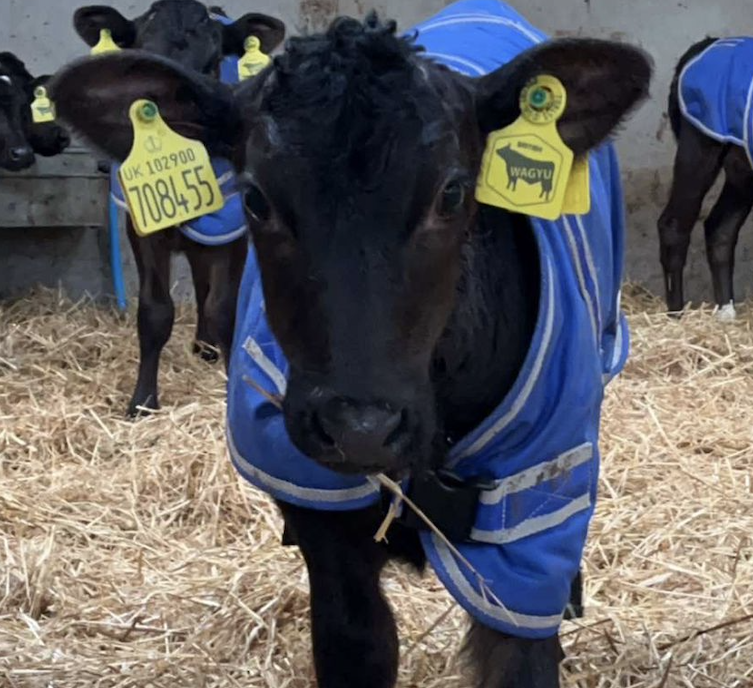
Calf jackets provide extra protection in cold weather. However, calves must be completely dry before wearing one and jackets must be thoroughly washed between uses (1).
6. Monitoring Growth Rates and Daily Liveweight Gain
Planning ahead for cold weather and preparing a sufficient winter calf feeding plan can help limit losses associated with cold stress.
Recording daily liveweight gain and feed intake helps form a baseline of calf performance and ultimately make changes before productivity drops too much. Comparing these values with the appropriate age and production stage will help gauge effectiveness.
If growth falls below target, review the ration, water access, housing and health with the relevant adviser. Do not assume that increased nutrition will result in improved performance and better cold weather resistance.
7. The Cost of Poor Winter Growth
Experiences in early life can have a lasting effect, influencing reproductive performance and carcass quality (15, 16). Prolonged cold stress also affects digestion, stress hormones, growth and development (17).
Experimentally, calves housed at -4 oC needed 32% higher maintenance energy than those housed at 10 oC (18). To compensate for the extra energy required to keep warm, cold-exposed calves usually eat more starter feed and sometimes need more antibiotics to fight infections (19).
In the Wagyu system, with recommended milestones at each of Warrendale’s four stages (production, rearing, growing, finishing), slower growth rates can translate to greater days on farm ultimately needing extra feed, bedding, labour and housing costs.
8. Five-Point Winter Calf Nutrition Checklist
- Recognise the signs of cold stress and act accordingly
- Measure daily minimum and maximum temperatures in calf housing to monitor conditions
- Review energy intake and adjust feeding where required using optimal starter feed
- Ensure housing provides adequate dry, warm conditions with access to fresh, clean water
- Consult a nutritionist for tailored advice and updated calf winter feeding regime
Review winter feeding with our nutritionist and use regular weighing to check calves are maintaining target growth.
Sources
- AHDB (n.d.). Calves in cold weather. Found at: https://ahdb.org.uk/knowledge-library/calves-in-cold-weather Accessed on: 21.10.2026
- Roland, L., Drillich, M., Klein-Jöbstl, D. and Iwersen, M., 2016. Invited review: Influence of climatic conditions on the development, performance, and health of calves. Journal of dairy science, 99(4), pp.2438-2452.
- Gluckman, P.D., Sizonenko, S.V. and Bassett, N.S., 1999. The transition from fetus to neonate–an endocrine perspective. Acta Paediatrica, 88, pp.5-11.
- Alexander, G., Bennett, J.W. and Gemmell, R.T., 1975. Brown adipose tissue in the new‐born calf (Bos taurus). The Journal of physiology, 244(1), pp.223-234.
- McCarthy, H.R., Chapelain, T., Pisoni, L., Kovacs, M., Echeverry-Munera, J., Wood, K.M., Renaud, D.L. and Steele, M.A., 2026. The expanding dairy-beef calf industry: Challenges and opportunities in pre-feedlot nutrition, health and welfare. Journal of Dairy Science.
- Qu, J., Zhou, X., Liu, J., Han, Z. and Qu, Y., 2026. Analysis of Behavioral, Growth and Metabolic Indicators in Suckling Calves Under Outdoor Winter Rearing Conditions Using Fuzzy Comprehensive Evaluation. Animals, 16(5), p.716.
- Arnold, M. (n.d.). Cold Stress and Newborn Calves. Department of Animal and Food Sciences. Found at: https://afs.mgcafe.uky.edu/dairy/cold-stress-and-newborn-calves Accessed on: 21.10.2026
- Wynnstay (2020). Keeping your calves warm during winter. Found at: https://www.wynnstay.co.uk/blog/baby-its-cold- outside/?srsltid=AU7gw4WN2FjHbc9IogFb-PO9VnlLhxMxwweroECV0oLcENyLh_nCrtDn Accessed on: 21.10.2026
- Drackley, J.K., 2025. Invited Review: The weaning transition in dairy calves—Why so traumatic?. Applied Animal Science, 41(3), pp.190-204.
- AHDB2 (n.d.). Rumen development in dairy calves. Found at: https://ahdb.org.uk/knowledge-library/rumen-development-in-dairy-calves Accessed on: 23.10.2026
- Burggraaf, V.T., Craigie, C.R., Khan, M.A., Muir, P.D., Thomson, B.C., Lowe, K.A., Leath, S.R., Taukiri, K.R., Staincliffe, M. and McCoard, S.A., 2020. Effect of feeding forage or concentrate starter diets in early life on life-time growth, carcass traits and meat quality of Wagyu× Friesian cattle. Animal Production Science, 60(15), pp.1850-1860.
- Khan, M.A., Burggraaf, V.T., Thomson, B., Muir, P., Lowe, K., Koolaard, J., Heiser, A., Leath, S. and McCoard, S., 2020. Feeding forage or concentrates early in life influences rumen fermentation, metabolic response, immune function and growth of Wagyu× Friesian calves. Animal Production Science, 60(11), pp.1418-1428.
- For Farmers (2023). Are your calves ready for winter? Found at: https://www.forfarmers.co.uk/news-knowledge/are-your-calves-ready-for-winter Accessed on: 23.10.2026
- AHDB3 (n.d.). Youngstock housing – Temperature, humidity and ventilation. Found at: https://ahdb.org.uk/knowledge-library/youngstock-housing-temperature-humidity-and-ventilation Accessed on: 21.10.2026
- Harvey, K.M., Cooke, R.F. and Moriel, P., 2021. Impacts of nutritional management during early postnatal life on long-term physiological and productive responses of beef cattle. Frontiers in Animal Science, 2, p.730356.
- Debnath, A., Elangbam, S., Pandey, A., Madhuri, P. and Michui, D., 2024. The hidden dangers of winter: A brief review how cold stress affects cattle production. Int J Vet Sci Anim Husb, 9(6), pp.152-6.
- Wang, S., Li, Q., Peng, J. and Niu, H., 2023. Effects of long-term cold stress on growth performance, behavior, physiological parameters, and energy metabolism in growing beef cattle. Animals, 13(10), p.1619.
- Scibilia, L.S., Muller, L.D., Kensinger, R.S., Sweeney, T.F. and Shellenberger, P.R., 1987. Effect of environmental temperature and dietary fat on growth and physiological responses of newborn calves. Journal of Dairy Science, 70(7), pp.1426-1433.
- Nonnecke, B.J., Foote, M.R., Miller, B.L., Fowler, M., Johnson, T.E. and Horst, R.L., 2009. Effects of chronic environmental cold on growth, health, and select metabolic and immunologic responses of preruminant calves. Journal of Dairy Science, 92(12), pp.6134-6143.


