


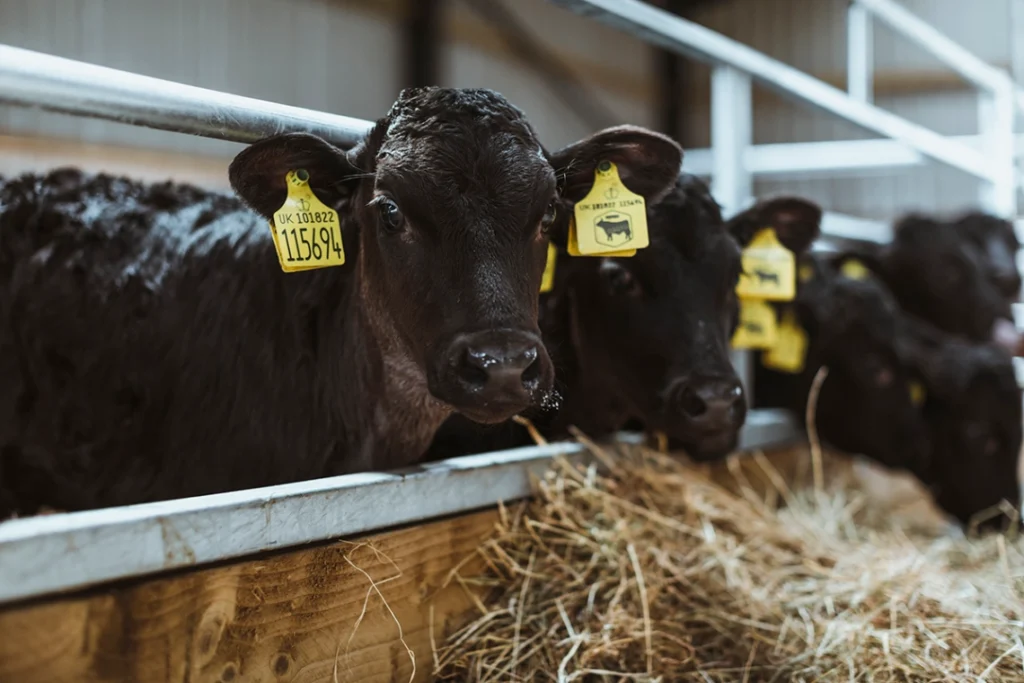
As temperatures drop, the risk of pneumonia increases, particularly in calves. Knowing what to look for and taking steps to reduce risk before cases appear can help protect calf health and performance as cooler weather approaches the UK.
What is pneumonia?
Bovine Respiratory Disease (BRD) is a disease affecting the respiratory system in cattle. Typically, when the upper respiratory tract is infected, the result is laryngitis and tracheitis and when the lower tract is infected (i.e. the lungs) it causes pneumonia (1).
These conditions are often the result of a combination of viral and bacterial infections and can be exacerbated by poor environmental conditions.
In the UK alone, pneumonia and other related respiratory diseases cost the cattle industry £50 million a year (2). These are due to treatment costs, poor performance and death (3). It is one of the most common diseases affecting calves and the leading cause of mortality and poor performance from birth through to weaning (2).
Many cases go unnoticed and are only discovered at slaughter. This means that poor growth rate and feed conversion efficiency can be affected without knowing the underlying cause.
Cases of pneumonia are more common in the colder, wetter months so, as we head into autumn and winter, there are steps that can be taken not only to diagnose respiratory disease but also reduce it.
How to recognise it in cattle
Early signs of pneumonia are indicative of a range of disorders making prompt diagnosis challenging. These general signs include lack of appetite, self-isolation, depression and fever (3). More specific clinical signs include increased heart rate, abnormal breathing, nasal and ocular discharge and coughing (4).
These symptoms can often go unnoticed and undiagnosed for some time. Furthermore, distinguishing between viral and bacterial causes, the stage of infection and whether it is the upper or lower respiratory tract that is infected present numerous challenges in diagnosing pneumonia and other bovine respiratory diseases (4).
Full checklist of pneumonia symptoms:
- Reduction in feeding
- Dull demeanour
- Isolation
- Dropping of the head
- Increased respiratory and heart rates
- Nasal discharge
- Eye discharge
- Cough
- Raised temperature
These are many of the symptoms identified in livestock suffering from pneumonia. Not all will present during infection, and many are indicative of other diseases and disorders. More recent research has investigated using machine learning to detect cases of BRD via behavioural changes within the herd (5). Observing feeding, movement and social behaviour can predict the onset of disease in young calves, however, further improvement in this area is needed before machine detection becomes a practical on-farm tool (5).
How to mitigate risks
All aspects of animal husbandry play a key role in not only detecting early onset of BRD but also preventing the risks in the first place.
Adequate Nutrition
From the moment a calf is born, its future health and success can be influenced within minutes. The sooner it receives colostrum, the better, but the amount it consumes is also important. A full 20 minutes of suckling is needed to ensure adequate intake, with feeding repeated within six to 12 hours to further strengthen the calf’s protection against disease (6).
Housing
As well as good nutrition, sufficient housing also plays a key role in the prevalence of BRD. Cattle are more likely to be housed during the colder, wetter months which increases the spread of diseases. Adequate airflow reduces pneumonia cases, as well as dry bedding and a warm indoor area. Rubber strips at the bottom of gates prevents wind chill and good drainage reduces moisture and pathogen build up (7).
Stress
However, it is not just environmental stress that can lead to fatalities. Emotional stress can also dampen the effectiveness of the immune response (;
). Incidences of BRD can be triggered following stressful events such as transportation and handling (3).
These effects tend to be cumulative (9). So, the more stressful events a calf is exposed to (castration, de-budding, weaning, excessive handling, transportation, poor housing), the lower its performance will be (9). Stressed calves will be more prone to illness than unstressed livestock. In one study, calves exposed to both viral and bacterial respiratory diseases were twice as likely to die if they had been weaned and separated from their mothers during this time (10).
Management
This knowledge allows farmers to take preventative action in reducing incidences of severe pneumonia. Avoiding stressful events such as transportation, change in feed, dehorning, and weaning during outbreaks of BRD can limit its impact on the herd. Similarly, changing management strategies to minimise stress can improve outcomes for example do not house and wean calves on the same day.
Ultrasound
Routine ultrasound scanning of calves can identify at-risk groups earlier and highlight effective management strategies to limit fatal cases on the farm. Ultrasound lung scanning, which must be completed before the calf reaches three months in age or 150 kg in weight, can detect lung lesions early and inform better treatment (11).
Vaccination
As with many viral and bacterial diseases, precautions can only limit their spread. You may have the best indoor environment for your cattle and have taken the time to limit their stress but pneumonia may still find its way into your herd. There is the option to vaccinate against pneumonia. In the UK, there are currently 17 vaccinations licensed for farm use (6) and it is important to vaccinate prior to poor weather setting in and stressful events such as weaning (12).
Full checklist to mitigate risks:
- Early and frequent access to colostrum
- Warm, dry housing
- Limit exposure to psychological stressors
- Manage stress through careful planning and herd management
- Routinely lung scan new calves
- Vaccinate
With autumn and winter approaching, early detection, good husbandry and careful management of nutrition, housing, stress and vaccination can all help farmers reduce the risk and severity of pneumonia in their herds.
Further reading
AHDB provides a comprehensive guide on Better management of Bovine Respiratory Disease.
Sources
- LLM Farm Vets (2025). Tips for mitigating respiratory disease in cattle before risk periods. Found at: https://llmfarmvets.co.uk/tips-for-mitigating-respiratory-disease-in-cattle-before-risk-periods/ Accessed on: 18.09.2026
- AHDB1 (n.d.). Pneumonia in calves. Found at: https://ahdb.org.uk/knowledge-library/pneumonia-in-calves Accessed on: 18.09.2026
- Gaudino, M., Nagamine, B., Ducatez, M.F. and Meyer, G., 2022. Understanding the mechanisms of viral and bacterial coinfections in bovine respiratory disease: a comprehensive literature review of experimental evidence. Veterinary research, 53(1), p.70. Found at: https://link.springer.com/article/10.1186/s13567-022-01086-1
- O’Donoghue, S., Waters, S.M., Morris, D.W. and Earley, B., 2025. A comprehensive review: Bovine respiratory disease, current insights into epidemiology, diagnostic challenges, and vaccination. Veterinary sciences, 12(8), p.778. Found at: https://www.mdpi.com/2306-7381/12/8/778
- Bushby, E.V., Thomas, M., Vázquez-Diosdado, J.A., Occhiuto, F. and Kaler, J., 2024. Early detection of bovine respiratory disease in pre-weaned dairy calves using sensor based feeding, movement, and social behavioural data. Scientific Reports, 14(1), p.9737. Found at: https://www.nature.com/articles/s41598-024-58206-4#Sec2
- AHDB2 (n.d.). Pneumonia vaccines in cattle. Found at: https://ahdb.org.uk/knowledge-library/pneumonia-vaccines-in-cattle Accessed on: 18.09.2026
- Agriwebb (2024). Keeping pneumonia at bay during the winter. Found at: https://www.agriwebb.com/blog/keeping-pneumonia-at-bay/ Accessed on: 18.09.2026
- Caswell, J.L., 2014. Failure of respiratory defenses in the pathogenesis of bacterial pneumonia of cattle. Veterinary pathology, 51(2), pp.393-409. Found at: https://journals.sagepub.com/doi/full/10.1177/0300985813502821
- AHDB3 (n.d.). Better management of Bovine Respiratory Disease. Found at: https://projectblue.blob.core.windows.net/media/Default/Imported%20Publication%20Docs/Better-management-of-bovine-respiratory-disease-BRD-pneumonia.pdf Accessed on: 18.09.2026
- Hodgson, P.D., Aich, P., Stookey, J., Popowych, Y., Potter, A., Babiuk, L. and Griebel, P.J., 2012. Stress significantly increases mortality following a secondary bacterial respiratory infection. Veterinary Research, 43(1), p.21. Found at: https://link.springer.com/article/10.1186/1297-9716-43-21
- AHDB4 (n.d.). Understanding pneumonia and lung scanning. Found at: https://ahdb.org.uk/knowledge-library/understanding-pneumonia-and-lung-scanning Accessed on: 18.09.2026
- Farm Progress (2025). Breathing easy: Protecting livestock from respiratory disease. Found at: https://www.beefmagazine.com/livestock-management/breathing-easy-protecting-livestock-from-respiratory-disease Accessed on: 18.09.2026


