



What is TechnoGrazing?
TechnoGrazing is a highly stocked cell-based approach to livestock production (1). It relies on grazing livestock in small, temporary cells or paddocks and moving them regularly, often every day (2). It is a more intensive form of rotational grazing, allowing farmers to use less land to deliver the same quantities of high-quality protein without damaging the soil or grass (1).
Benefits of the system
Farmers who have implemented TechnoGrazing on their farms report multiple benefits.
- Improved grass production
- TechnoGrazing increases the amount of high-quality grass and minimises waste (2). The system allows cells to be rested before re-grazing, keeping the grass healthy. Timing is crucial. When total grass falls below 1,250–1,500 kg DM/ha (3–4 cm), rest sustains quality and optimises performance (3).
- Improved grass and soil quality
- Sward quality and composition are improved with longer living leys. Even manure distribution enhances soil health, organic matter (2) and nutrient recycling (4). The pasture itself can be more precisely managed over each cell including special management of secondary forages (5). Regular movement of cattle minimises soil compaction and grass damage (6).
- Improved livestock production and cattle health
- Regular rotations with optimal rest periods extends the grazing season and reduces worm infestation and therefore the need for anthelmintics (5). Other pasture-based disorders such as facial eczema and bloat are also reduced (4). Animals are reportedly calmer and more easily monitored (5). Animal appetite is stimulated with frequent fresh pasture, providing a more consistent diet (4).
- Reduced guesswork, better planning
- Having pasture mapped out for the coming days allows farmers to visualise how much food is available and for how long (7).
Challenges of the system
Whilst there is clear evidence of success from implementing a TechnoGrazing system on your farm, challenges remain. There is daily or near-daily movement of fences and cattle. Upfront costs can surpass £3,000 depending on farm size and system design and, as with all new systems, there will be a learning curve for both farmer and livestock.
Both the founder of TechnoGrazing and farmers who have seen positive results from using it, stress that poor implementation of the system may lead to negative outcomes. These include reduced grass health and growth and impaired livestock performance and profits. Furthermore, other factors influence the success of a TechnoGrazing system. Even if implemented well, unpredictable weather can impact grass growth, soil health and cattle outputs.
Infrastructure required to set the system up
The TechnoGrazing system uses semi-permanent fences to construct lanes using fibreglass posts and high tensile polywire which springs into place. These lanes are then sub-divided into 0.1 ha cells using electrical fencing (4). The temporary fences can be erected and dismantled quickly and easily using a modified quad bike fitted with bars that allow the bike to drive over the fence unhindered (4). The fence then springs back into place afterwards. Creating new cells and moving cattle onto fresh pasture becomes a straightforward daily task.
Installing water access in all cells can be a challenge however, Harry Wier, who developed the concept of TechnoGrazing, has implemented permanent micro-troughs on his farm (4). Water bowls attach to extendable water pipes that you pull to each new cell using the quad bike before staking in place.
Typical Cost Considerations
You need to consider set up costs, ongoing maintenance and labour prior to TechnoGrazing.
To calculate the return on investment, a trial on a beef farm in Cornwall, UK, was set up using TechnoGrazing. Forty-five homebred black Limousin steers and heifers were grazed in 64, 0.01ha cells over the trial period. Daily liveweight gain was reduced, but finishing weights remained similar, with overall production per hectare increasing due to higher stocking density. In five months, the capital cost of the fencing materials, installation and water amounting to £3,146 was paid off and by the end of the trial extra income increased by 61% (2).
Other farms report between 65-110% increase in liveweight gain and often a doubling in stocking densities following implementation of TechnoGrazing (4).
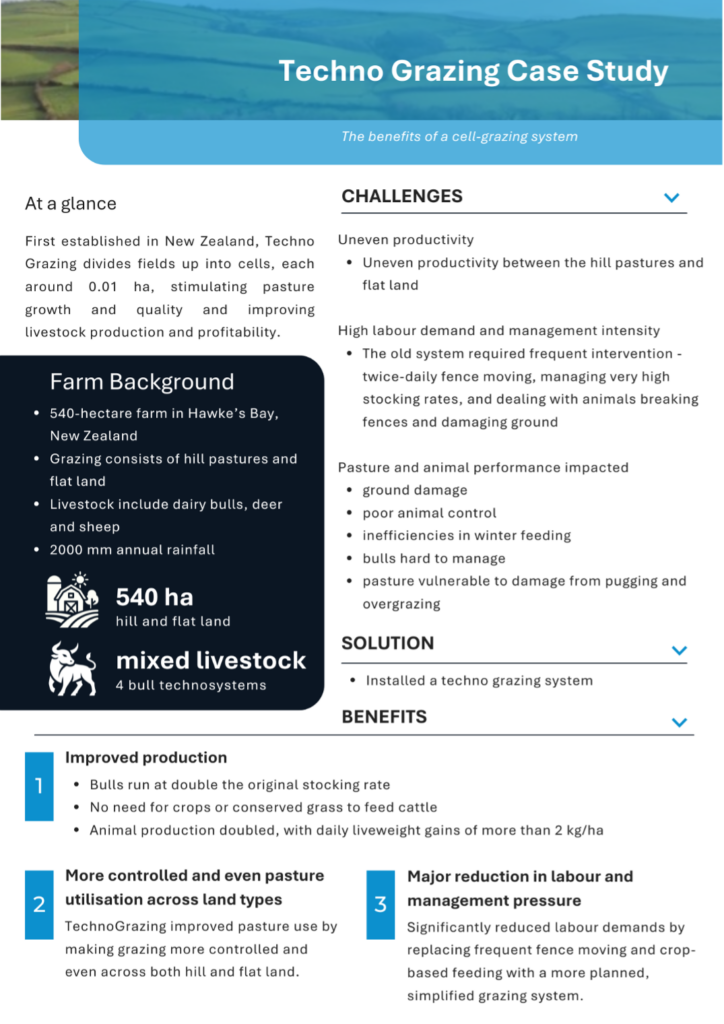
Summary
TechnoGrazing can deliver clear improvements in grass utilisation, stocking density and cattle performance when managed well. However, it is a highly structured system that requires consistent labour input, careful planning and suitable infrastructure to achieve its full benefits. While some farms report strong financial returns and improved productivity per hectare, success depends heavily on implementation, local growing conditions and farmer experience. For those able to commit to the system, it can be a valuable tool for maximising grass-based production.
Find out more about Warrendale’s grazing strategies and expert-nutritionist tips on feeding cattle at all stages of the rearing cycle.
Sources
- Rothamstead Research (n.d.) Soil structure maintained in more densely stocked cell-grazed pastures. Found at: https://www.rothamsted.ac.uk/news/soil-structure-maintained-more-densely-stocked-cell-grazed-pastures Accessed on: 15.06.2026
- Talking Grass (2016). Techno-grazing UK style. Found at: https://www.talkinggrass.co.uk/2016/11/08/techno-grazing-uk-style/ Accessed on: 15.06.2026
- AHDB (n.d.). Understanding grass growth for beef rotational grazing. Found at: https://ahdb.org.uk/knowledge-library/understanding-grass-growth-for-beef-rotational-grazing Accessed on: 15.06.2026
- Charlton, J.F.L. and Wier, J.H. (2001). TechnoGrazing – a new grazing concept. Proc. New Zealand Grassl. Assoc., 63 (2001), pp. 33-36
- Kiwitech International Ltd (2017). TechnoGrazing: Making rotational grazing easy and fast. Found at: https://www.youtube.com/watch?v=zymjPcYnadA Accessed on: 15.06.2026
- Romero-Ruiz, A., Rivero, M.J., Milne, A., Morgan, S., Meo Filho, P., Pulley, S., Segura, C., Harris, P., Lee, M.R., Coleman, K. and Cardenas, L., 2023. Grazing livestock move by Lévy walks: Implications for soil health and environment. Journal of Environmental Management, 345, p.118835.
- Countrywide (2023). Techno grazing making good sense. Found at: https://country-wide.co.nz/techno-grazing-making-good-sense/ Accessed on: 15.06.2026


