

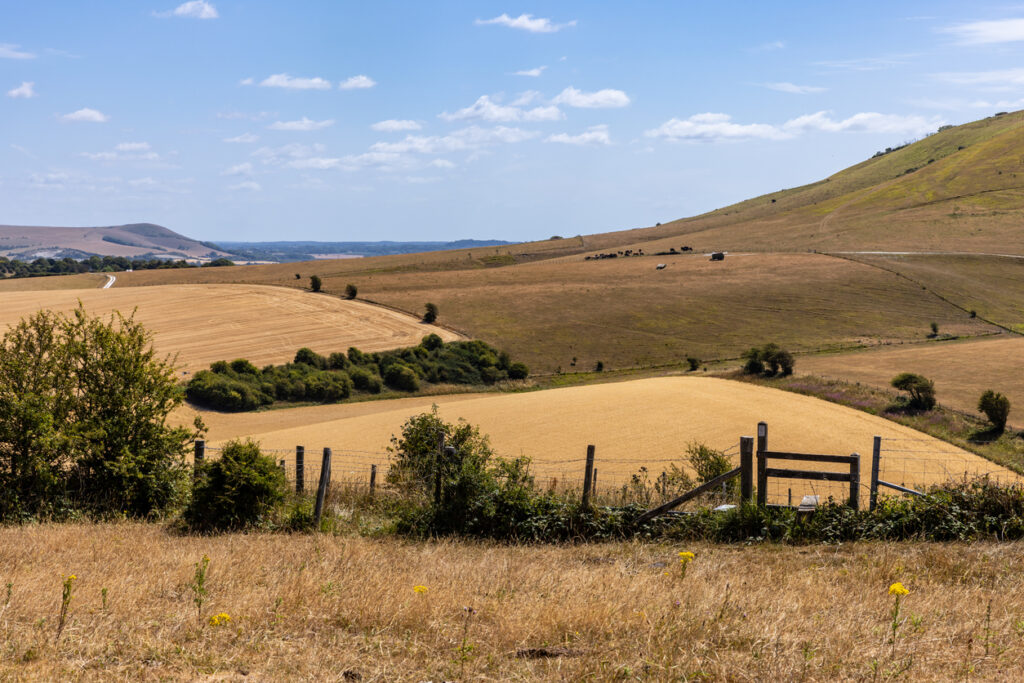
With hosepipe bans in place across much of the UK, scorching temperatures and little to no precipitation for weeks on end, drought has recently gripped the nation. For farmers, the impact is noticeable and could persist into the winter.
So, what can be done to minimise future risks and how can farmers prepare for the coming winter following such a prolonged dry spell?
What is drought and is it really becoming more frequent?
A meteorological drought is defined by the IPCC as a region receiving lower than average rainfall (1). These periods of drought can last from weeks to years and progress onto agricultural drought (affecting crops and livestock) and hydrological drought (affecting water storage and flow; 2).
In August this year (2026), a drought was declared on more than 70% of England with rising temperatures and minimal precipitation. Predictions project increasingly dry UK summers (1). While some suggest this is largely attributed to human-induced climate change and volatility with heatwaves exacerbating the problem (2), others suggest there is no definitive evidence of this (3). Instead, droughts may be more associated with a combination of rainfall deficits, heatwaves, and natural variations in atmospheric and oceanic circulation (3).
However, it is the variability of the climate and the greater extremes that is a concern (4). Recent summers have been very hot and dry suggesting that we need to be more prepared for greater climate variability and more frequent extreme conditions.
Tactics for this year
The immediate priority is to reduce demand while protecting the resources that remain. After a challenging summer season, dipping into winter feed supplies early and making difficult herd management decisions, farmers are looking to the winter to mitigate any losses. Advice is to cull empty or inefficient livestock to reduce winter feed requirements (5). And if managing a dairy herd, then drying autumn calvers off earlier minimises the nutritional requirement of the herd (5).
It will take time before soil moisture is restored and pastures return to normal so grazing management is also important over the coming months. As the dry spell continues, extending the pasture rest periods in a rotational grazing system gives the grass a greater chance to recover (6).
If feed and forage is in short supply, then baled silage can often be fed sooner than clamp silage (5). Increased stocking density can improve uniform grazing and reduce selective grazing which can increase the chances of ingesting toxic plants (6). Recently, hemlock poisoning has been reported in Wales during dry spells (7).
As well as livestock and grazing management, maintaining water pipes, water sources and slurry infrastructure will improve water efficiency across the farm (7).
And it’s not just feed and water that could be in short supply after a drought year.
Following a poor cereal harvest, less straw may be available. This means planning ahead for winter straw requirements and sourcing alternative bedding materials to reduce costs and avoid shortages later in the season (5).
Are there differences between dairy and beef cattle?
Both beef and dairy cattle are affected by drought and subsequent heat stress.
Forage yield and quality drop in drought conditions (8), which directly affects milk yield in dairy cattle. Furthermore, lactating dairy cows require greater volumes of water than beef animals (as much as 150 litres per day; 9) and they are more susceptible to heat stress. More productive dairy breeds exhibit greater sensitivity to heat stress as they are generally larger and emit higher metabolic heat (10).
The effects of heat stress on beef cattle can be more subtle as daily fluctuations in productivity are less apparent than they are with milk yields. However, liveweight gain and body condition can deteriorate from indirect drought effects. Heat stress during early pregnancy can increase embryo mortality and reduce foetal weight (11). It negatively impacts reproductive rates and feed intake and can affect behaviour (12).
For beef producers, the consequences can extend beyond growth and reproduction, with drought-related changes in pasture quality potentially affecting meat quality. Higher muscle glycogen prevents poor-quality beef. Levels fluctuate seasonally with higher levels associated with peaks in pasture quantity and quality during springtime (13).
Preparing for the future to be more drought resilient
Any farmer knows the impact of drought. From crop failures, soil damage and increased pests and disease to a drop in animal productivity and increased incidence of heat stress.
So, what can be done to become more drought resilient?
Here are some suggested Action Points:
- Develop a drought plan before drought occurs – include fodder budgets, grazing management, stocking rates, feed reserves and water supplies (14).
- Improve farm infrastructure – better ventilation, additional housing, reliable power supplies and efficient milking facilities (15).
- Adapt grazing management – adjust stocking rates to available forage, extend pasture recovery periods and consider alternative grazing systems such as mob grazing (15).
- Build more resilient forage systems – reseed pastures and select grass varieties with different root depths and greater climate resilience. Shorter-season maize and drought-resistant crops such as fodder beet can help maintain feed supplies (15).
- Increase shade and protect soil moisture – plant trees and hedgerows to provide shade for livestock and reduce soil temperatures and moisture loss (16).
- Use breeding and selection to improve resilience – genetically select smaller-framed cows with lower forage requirements and maintain desirable traits to tolerate harsh environmental conditions (15; 14).
- Spread financial risk through diversification – integrate crop production with livestock or develop additional farm enterprises where appropriate (Wheeler).
- Reduce exposure to supply-chain disruption – for example through direct selling and shorter supply chains, while planning ahead for potential transport and power disruptions (15).
Whilst we may not be able to eliminate the effects of drought entirely, we can prepare ourselves beforehand. Managing grazing and feed resources, securing reliable water sources and adapting livestock and forage systems can help farmers and farms cope with climatic variability. The experience of 2026 provides an opportunity to learn from the challenges and put measures in place now, before the next drought arrives.
Click here to read our blogs on managing heat stress.
Sources
- Met Office (n.d.). UK and Global extreme events – Drought. Found at: https://www.metoffice.gov.uk/research/climate/understanding-climate/uk-and-global-extreme-events-drought Accessed on: 25.8.2026
- Mabhaudhi, T., 2026. The UK drought is a warning: Climate change is a food and public health emergency. bmj, 394.
- Hannaford, J., Turner, S., Chevuturi, A., Chan, W., Barker, L. J., Tanguy, M., Parry, S., and Allen, S. (2025). Have river flow droughts become more severe? A review of the evidence from the UK – a data-rich, temperate environment, Hydrol. Earth Syst. Sci., 29, 4371–4394
- Godde, C.M., Mason-D’Croz, D., Mayberry, D.E., Thornton, P.K. and Herrero, M., 2021. Impacts of climate change on the livestock food supply chain; a review of the evidence. Global food security, 28, p.100488.
- AHDB (2020). Tips on managing prolonged dry conditions. Found at: https://ahdb.org.uk/news/top-tips-on-managing-prolonged-dry-conditions Accessed on: 25.8.2026
- The Cattle Site (2019). Beef Drought Management Strategies. Found at: https://www.thecattlesite.com/articles/4375/beef-drought-management-strategies Accessed on: 25.8.2026
- Environment Agency (2025). Winter farm preparation: a guide for farmers after a dry season. Found at: https://environmentagency.blog.gov.uk/2025/10/02/winter-farm-preparation-a-guide-for-farmers-after-a-dry-season/ Accessed on: 25.8.2026
- Liu, W., Liu, L., Yan, R., Gao, J., Wu, S. and Liu, Y., 2023. A comprehensive meta-analysis of the impacts of intensified drought and elevated CO2 on forage growth. Journal of Environmental Management, 327, p.116885.
- Golher, D.M., Patel, B.H.M., Bhoite, S.H., Syed, M.I., Panchbhai, G.J. and Thirumurugan, P., 2021. Factors influencing water intake in dairy cows: a review. International Journal of Biometeorology, 65(4), pp.617-625.
- Cheng, M., McCarl, B. and Fei, C., 2022. Climate change and livestock production: a literature review. Atmosphere, 13(1), p.140.
- Biggers, B.G., Geisert, R.D., Wetteman, R.P. and Buchanan, D.S., 1987. Effect of heat stress on early embryonic development in the beef cow. Journal of animal science, 64(5), pp.1512-1518.
- Muzzo, B.I., Ramsey, R.D. and Villalba, J.J., 2024. Changes in climate and their implications for cattle nutrition and management. Climate, 13(1), p.1.
- Knee, B.W., Cummins, L.J., Walker, P. and Warner, R., 2004. Seasonal variation in muscle glycogen in beef steers. Australian Journal of Experimental Agriculture, 44(8), pp.729-734.
- Salmoral, G., Ababio, B. and Holman, I.P., 2020. Drought impacts, coping responses and adaptation in the UK outdoor livestock sector: Insights to increase drought resilience. Land, 9(6), p.202.
- Wheeler, R. and Lobley, M., 2021. Managing extreme weather and climate change in UK agriculture: Impacts, attitudes and action among farmers and stakeholders. Climate Risk Management, 32, p.100313.
- Morrison, D. (2026). Farmer Focus: Drought mitigation priority as smoke clears. Farmer’s Weekly. Found at: https://www.fwi.co.uk/livestock/livestock-farmer-focus/farmer-focus-drought-mitigation-priority-as-smoke-clears Accessed on: 25.8.2026


