


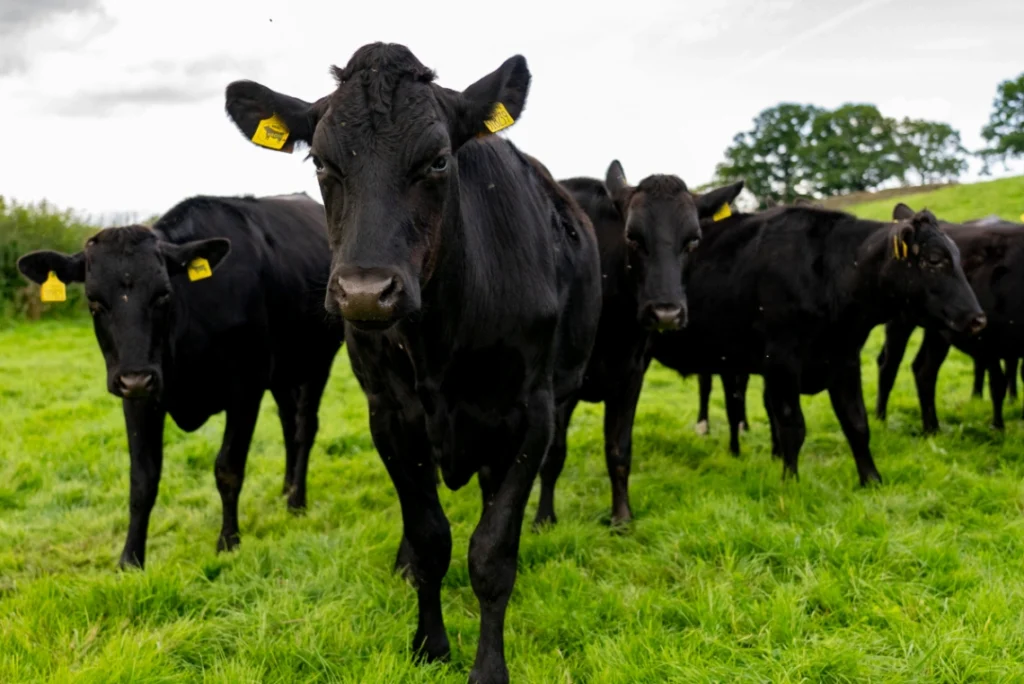
Wagyu beef is renowned for its intense marbling, sweet and fatty aroma and buttery taste. A common misconception is that this is solely due to the genetics of the animal and high energy feed, but Wagyu is about so much more than that. Marbling isn’t rushed or manufactured early in life. Instead, it is built over time through consistent nutrition, low-stress handling, and a structured grazing system.
Early Life: Build the Animal (not the marbling)
In the UK, Wagyu beef breeds are typically crossed with Holstein cattle utilising both the dairy and beef industries. Bringing in the dairy cattle slows down the maturity and has a natural marbling that complements the Wagyu (1).
Wagyu beef cattle appear to be predisposed to greater intramuscular fat than other breeds of beef. Twelve-month-old wagyu cattle have fewer muscle stem cells, fewer muscle fibres and a higher capacity to form fat cells compared to Angus beef (2).
This predisposition suggests that feeding Wagyu cattle energy dense diets will have less of an effect than originally thought. This is supported by research comparing the effects of a forage versus concentrate starter diet. The research found that for the first 14 weeks, forage-fed calves grew slower than their concentrate-fed counterparts, however, once on pasture they had a greater daily liveweight gain (3). Early life diets influence the rumen microbiome, and in this case, the forage starter likely primed the cattle for better utilisation of forages. Wagyu and wagyu-cross cattle gain on average 0.8-1 kg liveweight per day on grass (1).
By 10 months of age, muscle and fat deposition was similar between the two groups of calves (3). Liveweight and meat characteristics such as fat, colour, pH, marbling and shear force was similar at slaughter regardless of which diet the calves had been raised on (4).
This research suggests that there are no economical benefits to concentrate feeding Wagyu beef calves. Grazing the livestock on pasture produces similar results to early life high energy diets.
For farmers, this offers a low-cost rearing and growing strategy that not only produces excellent quality beef but also offers advantages environmentally. Grazing livestock outdoors reduces the need for housing and its associated costs and lower concentrate diets reduce input costs.
Grazing Phase: Consistency is Key (and so is low stress)
While early life builds the animal’s capacity to perform, it is the grazing phase where consistency begins to shape long-term outcomes.
In Japan, the origin of Wagyu beef, small-scale farming is the principal method for Wagyu beef production (5). This less intensive farming provides better animal welfare and creates less stress for the animals. Stress can negatively impact the immune system, growth, and reproduction and therefore productivity (6). Organic farming which provides good quality feedstuffs as well as animal and management practices that promote health and welfare results in fewer condemnations at slaughter compared to intensive and conventionally reared cattle (7).
The characteristic marbling of Wagyu beef is responsible for its flavour, tenderness and juiciness and it can be impacted by stress. Stress hormones such as cortisol and adrenaline suppress insulin which is essential for marbling formation (8). Reduced insulin shifts the body away from fat storage to energy mobilisation limiting intramuscular fat deposition (8). So calm, well-fed animals will naturally produce greater marbling and therefore better quality beef.
Rotational grazing creates a consistent management system for Wagyu beef. Moving cattle regularly from one field to the next not only provides them with fresh pasture but also allows the grass to recover, releases natural nutrients into the soil, and optimises feed availability. This sustainable beef production system requires fewer inputs, can extend the grazing season, and produces better-quality beef.
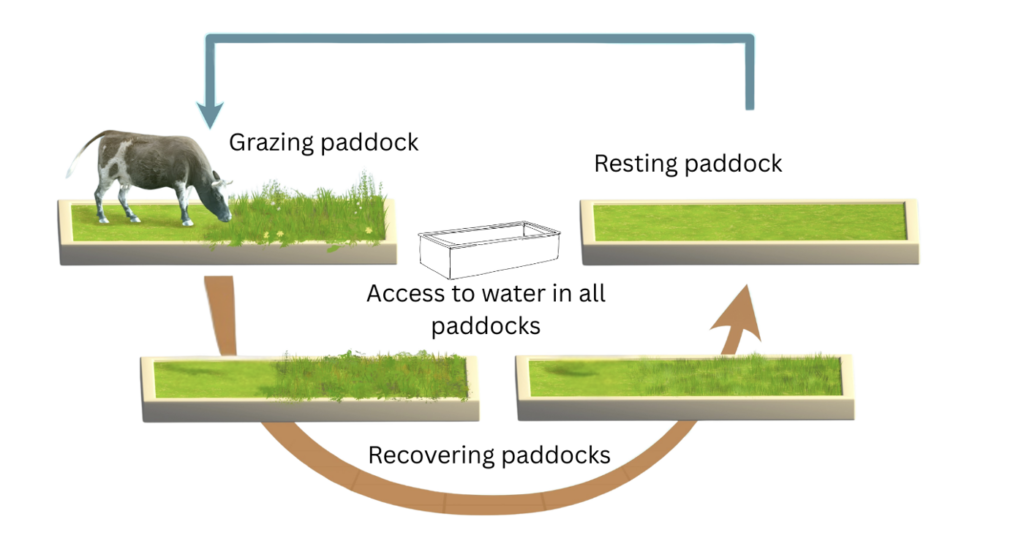
Diagram showing the practice of rotational grazing – cattle are regularly moved from one paddock to the next, giving the grass time to recover and grow, providing consistent forage for the livestock and regular nutrients from the livestock to the soil.
Stress reduction and illness mitigation is key.
While subcutaneous fat is laid down relatively quickly and often towards the end of an animal’s life as growth slows, intramuscular fat responsible for marbling is a slower process (9). Therefore, it is important to consider the mechanisms behind intramuscular fat deposition and try to optimise those.
Management practices that reduce stress and illness and those that provide consistent, high-quality feed improve marbling in Wagyu beef (9). The Wagyu grazing system highlights the fact that nutrition provided throughout the animal’s lifetime is crucial to the end goal.
For farmers, rotational grazing used in Wagyu production is sustainable, more environmentally friendly than indoor systems, and provides a multitude of ecosystem services such as improved soil structure and health, grassland biodiversity, and increased invertebrate richness.
Finishing Phase: Where Marbling is Made
The finishing phase also plays an important role in the exceptional carcass traits of Wagyu beef. Traditionally, Wagyu cattle are finished over an extended period of time and on high energy diets. Intramuscular fat deposition requires energy intake above normal production requirements and even higher energy levels than those required for general fat deposition (10).
Wagyu cattle in Japan are fed increasingly high concentrate diets from 11-30 months of age, as high as 86% concentrate to induce intramuscular fat deposition (10).
The finishing phase in Japanese black cattle or F1 Wagyus is typically as follows (10):
- 11-18 months of age: 36.8-86.4% concentrate
- 18-30 months (slaughter): 84.2-86.4% concentrate
- Roughage, comprising mostly rice straw, makes up the rest of the diet
- Mid-fattening stage: vitamin A is restricted
There is a fine balance between feeding the right amount of energy and too much. Feeding excessively energy-rich diets during the finished phase can produce visceral and subcutaneous fat unsuitable for human consumption and increase feed costs threatening the sustainability of the system (11). Other management practices, such as those already mentioned, along with restricting vitamins A and D, supplementing with vitamin C, castration and early weaning also have positive effects on marbling (11).
Although feed efficiency declines with increasing age due to a decreased rate of muscle growth, increasing slaughter age allows time for muscle maturity and the accumulation of intramuscular fat (10). This extended finishing phase, far longer than other breeds of cattle, is key to the Wagyu beef industry giving it its signature marbling, texture and flavour.
For farmers, a controlled and consistent finishing strategy ensures that the genetic potential built earlier in life is fully realised, delivering predictable marbling and repeatable carcass quality.
What this system delivers
With its high marbling characteristic, Wagyu beef offers high profitability on a relatively low-stress, efficient feeding system that produces high quality beef. Utilising rotational grazing results in more efficient use of pasture systems through reduced inputs and ultimately better quality forage for livestock. Furthermore, understanding that early life nutrition is not the only factor in marbling later in life, reduces the need for high energy starter diets and higher rearing costs.
These management standards not only produce marbling consistency, better eating quality and repeatable outcomes for the farmer, but create stronger animal welfare outcomes which in itself is a driver for premium consumer prices.
References
- Farmer’s Weekly (2018). How Wagyu beef scheme gives farmers stability. Found at: https://www.fwi.co.uk/livestock/beef/new-wagyu-beef-scheme-providing-farmers-stability Accessed on 24.03.26
- Fu, X., Yang, Q., Wang, B., Zhao, J., Zhu, M., Parish, S.M. and Du, M., 2018. Reduced satellite cell density and myogenesis in Wagyu compared with Angus cattle as a possible explanation of its high marbling. Animal, 12(5), pp.990-997.
- Khan, M.A., Burggraaf, V.T., Thomson, B., Muir, P., Lowe, K., Koolaard, J., Heiser, A., Leath, S. and McCoard, S., 2020. Feeding forage or concentrates early in life influences rumen fermentation, metabolic response, immune function and growth of Wagyu× Friesian calves. Animal Production Science, 60(11), pp.1418-1428.
- Burggraaf, V.T., Craigie, C.R., Khan, M.A., Muir, P.D., Thomson, B.C., Lowe, K.A., Leath, S.R., Taukiri, K.R., Staincliffe, M. and McCoard, S.A., 2020. Effect of feeding forage or concentrate starter diets in early life on life-time growth, carcass traits and meat quality of Wagyu× Friesian cattle. Animal Production Science, 60(15), pp.1850-1860.
- Motoyama, M., Sasaki, K. and Watanabe, A., 2016. Wagyu and the factors contributing to its beef quality: A Japanese industry overview. Meat Science, 120, pp.10-18.
- Jurkovich, V., Hejel, P. and Kovács, L., 2024. A review of the effects of stress on dairy cattle behaviour. Animals, 14(14), p.2038.
- Blanco-Penedo, I., López-Alonso, M., Shore, R.F., Miranda, M., Castillo, C., Hernández, J. and Benedito, J.L., 2012. Evaluation of organic, conventional and intensive beef farm systems: health, management and animal production. Animal, 6(9), pp.1503-1511.
- Van Tonder, E. (2025). Why Marbling Happens and How Stress Changes Fat Distribution in Beef. Found at: https://earthwormexpress.com/the-meat-factory/meat-science-research/why-marbling-happens-and-how-stress-changes-fat-distribution-in-beef/ Accessed on 24.03.26
- The Beef Site (2009). Management Practices to Improve Beef Quality Found at: https://www.thebeefsite.com/articles/1959/management-practices-to-improve-beef-quality Accessed on 24.03.26
- Park, S.J., Beak, S.H., Kim, S.Y., Jeong, I.H., Piao, M.Y., Kang, H.J., Fassah, D.M., Na, S.W., Yoo, S.P. and Baik, M., 2018. Genetic, management, and nutritional factors affecting intramuscular fat deposition in beef cattle—A review. Asian-Australasian journal of animal sciences, 31(7), p.1043.
- Csapó, J. and Kari, A., 2025. Factors influencing marbling in beef cattle. A review. Acta Universitatis Sapientiae, Alimentaria, 18(4), pp.70-97.


