


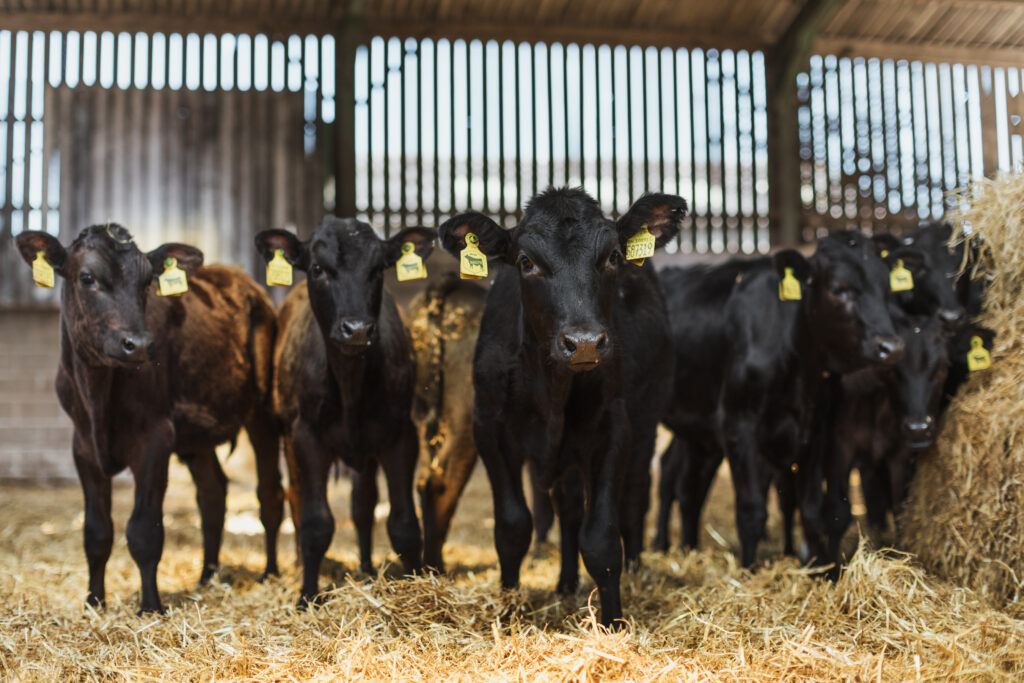
Why Stress-Free Handling Matters
Cattle handling is an essential and routine part of livestock management. It is vital to verify performance, assess health, record growth, measure body condition scores and know when your cattle are ready for slaughter.
But weighing and moving cattle can trigger stress responses which have detrimental effects on daily liveweight gain (DLWG; 1), meat quality (2) and performance (3). The process is also labour-intensive and can of course be unsafe for farm workers.
How Stress Affects Cattle Performance
Repeated handling, moving cattle away from their resting areas, disrupting their routine and restraint all result in stress (4). This elevates cortisol levels which in turn reduces feed intake and ultimately lowers growth rates (5) and impacts body condition score (BCS).
Research shows that animals that have a higher stress response can grow 7% more slowly than calmer cattle and produce 17% more methane making them less efficient (6).
Individually, the economic impact may not seem like much, but repeated stressful handling can have an effect on long-term herd performance costing thousands of pounds over the entire year.
Special importance for wagyu cattle
Wagyu beef cattle can be sensitive to the negative effects of stress. The meat quality relies heavily on marbling, colour and pH balance. Pre-slaughter and handling stress can raise muscle pH. During the natural conversion of muscle to meat, the pH typically drops but this doesn’t happen in animals that have experienced chronic stress (7).
It doesn’t mean that the breed aren’t hardy, but with a premium product, it makes a difference. Stress creates tougher, less palatable meat, with an abnormal colour, higher water retention and higher cooking loss (8). All of these effects reduce carcass value.
Why handling can cause stress
There are many causes of stress during the handling process but some of these are avoidable with better systems, newer technology and a greater understanding. Loud noises, sudden movements and overcrowding can trigger a stress response in cattle (9).
This highlights the importance of well-designed handling facilities. Poorly designed systems, rough or inconsistent stockmanship, and prolonged time in races or crushes, all increase stress and therefore welfare and productivity.
Best Practices for Stress-Free Handling
Behaviour
Understanding what causes the most stress to cattle allows us to minimise it. Moving cattle calmly and quietly; using well designed race systems; and minimising time spent in handling facilities reduces cattle exposure to stressful stimuli.
But there are also new technologies and equipment that can, not only reduce handling impact, but also labour time and costs.
Technology
Automated weighing systems attract animals to a weigh platform by offering feed or water at the same time (10). This allows farmers to track the growth rate and performance of their livestock more accurately and in greater detail. Rather than weighing animals just a few times each year, automatic weighing scales take multiple, daily measurements creating a far more accurate record of animal performance whilst also tracking feed and/or water intake. It also means that you can identify needs to intervention early, where anonmalies in data can suggest illness, for example.
Further technological advances incorporate temperature tracking and gait analysis at each station. Therefore, we have an early indication of disease, distress or underperformance (11). More predictive technology uses image-scanning apps to predict the weight of an animal from its measurements as it walks into view (12).
Benefits of Low-Stress Handling
Time and Productivity
These hands-free approaches offer low-stress handling solutions for cattle. Less time is wasted in holding areas where productivity drops and portable weighing platforms can be used anywhere on the farm. This allows them to be used out in the field and supports more natural behaviour which ultimately reduces stress.
Welfare and Performance
These techniques allow more time for feeding and resting and improve daily liveweight gain and feed conversion. Our previous blog post highlighted the importance of animal welfare in Wagyu beef production and low-stress performance measurements are an important factor in that. Bruising and injuries will be fewer in a calmer environment with fewer condemnations at slaughterhouses.
Data Collection and Decision-making
More consistent, low-stress data collection also improves decision-making. Regular, accurate DLWG and BCS measurements allow farmers to identify underperforming animals earlier, adjust feeding strategies and make more informed finishing decisions. This then reduces guesswork and helps ensure cattle are marketed at the optimal time for both weight and condition.
Conclusion
In any Wagyu beef cattle enterprise, measuring animal performance is paramount to optimising productivity. However, common measuring practices induce a stress response in cattle which not only affects animal welfare, but also animal performance, carcass traits and profitability.
Stress can limit intramuscular fat deposition affecting the marbling that Wagyu is renowned for (13). Low-stress handling therefore plays a vital role in the Wagyu beef industry, and farmers and stockmen should understand the importance of low-stress environments and handling.
These include:
- Calm handling procedures
- Avoiding loud noises and sudden movements
- Reducing unproductive time spent in races or crushes
- Considering implementing automatic weigh scales
Ultimately, low-stress measurement isn’t just about welfare, it’s about better data, better performance and better returns.
Sources
- Ligon, J.M., 2015. The effects of low stress cattle handling and weaning training on post-weaning weight gain and calf activity (Doctoral dissertation, Virginia Tech).
- Xing, T., Gao, F., Tume, R.K., Zhou, G. and Xu, X., 2019. Stress effects on meat quality: a mechanistic perspective. Comprehensive Reviews in Food Science and Food Safety, 18(2), pp.380-401.
- Fernandez-Novo, A., Pérez-Garnelo, S.S., Villagrá, A., Pérez-Villalobos, N. and Astiz, S., 2020. The effect of stress on reproduction and reproductive technologies in beef cattle—A review. Animals, 10(11), p.2096.
- Grandin, T. and Shivley, C., 2015. How farm animals react and perceive stressful situations such as handling, restraint, and transport. Animals, 5(4), pp.1233-1251.
- Gouvêa, V.N., Cooke, R.F. and Marques, R.S., 2022. Impacts of stress-induced inflammation on feed intake of beef cattle. Frontiers in Animal Science, 3, p.962748.
- SRUC (2016) Stress and its effects on cattle efficiency. Found at: https://www.sruc.ac.uk/media/8d8ee1a647f51d6/stress-and-its-effects-on-cattle-efficiency.pdf Accessed on: 12.4.26
- AHDB (n.d.) How pre-slaughter stress impacts meat quality. Found at: https://ahdb.org.uk/knowledge-library/how-pre-slaughter-stress-impacts-meat-quality Accessed on: 12.4.26
- Birhanu, A.F., 2020. Pre-slaughter stress, management of stress and its effect on meat and carcass quality. Int J Food Sci Agric, 4(1), pp.30-7.
- Lanier, J.L., Grandin, T., Green, R.D., Avery, D. and McGee, K., 2000. The relationship between reaction to sudden, intermittent movements and sounds and temperament. Journal of animal science, 78(6), pp.1467-1474.
- Uskenov, R., Mirmanov, A., Bostanova, S. and Tretyakov, I., 2023. Automatic cattle weighing on pastures with behavioral analysis during drinking.
- Herd Advance (n.d.). Stockman – The Super Herd Solution. Found at: https://www.herdadvance.co.uk/technology/stockman Accessed on: 12.4.26
- Scanabull (n.d.). Weigh cattle in seconds, without the crush or guesswork. Found at: https://scanabull.com/ Accessed on: 12.4.26
- Van Tonder, E. (2025). Why Marbling Happens and How Stress Changes Fat Distribution in Beef. Found at: https://earthwormexpress.com/the-meat-factory/meat-science-research/why-marbling-happens-and-how-stress-changes-fat-distribution-in-beef/ Accessed on 12.4.26


