

Warrendale shines at Aldi supplier conference
News
27th Mar 2026
Warrendale shines at Aldi supplier conference
Warrendale shines at Aldi supplier conference.
The Aldi Supplier Conference 2026 brought together suppliers from across the UK food industry to hear about Aldi’s strategy, priorities and expectations for the coming years. The message from Aldi leadership was clear: the retailer is continuing to grow rapidly and suppliers who align with their model of value, quality and availability will be well positioned for success.
What was clear from the conference, is that there is a lot of love for wagyu and for Warrendale. Not only is Warrendale is key example of how suppliers can leverage a long-term relationship with a retailer for its own growth, but wagyu products are the pinnacle of affordable luxury for Aldi’s increasing customer base.
Warrendale’s wagyu is what is served at corporate meetings or events and is the product of choice for Aldi leadership.
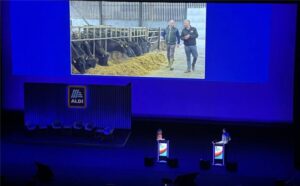
The relationship between Warrendale and Aldi was demonstrated through a case study video that was shown in the keynote speech towards the start of the conference.
Below are the key themes from the conference and what they mean for Warrendale Wagyu. You can watch the video here.
Premium beef finding its place in a value-led model
The Warrendale case study
One of the standout themes from the event was the growing role of premium products within Aldi’s tightly curated range. Wagyu was positioned as an example of “affordable luxury” – a product that allows shoppers to trade up while still feeling they are getting strong value.
This reflects a broader shift in consumer behaviour. Even in a cost-conscious market, shoppers are increasingly willing to spend more on quality for specific occasions. For farmers, this signals continued demand for high-quality beef that can justify a premium, provided it is consistent and accessible.
The long-term relationship between Aldi and Warrendale Wagyu was highlighted as a case study during the conference, demonstrating how close collaboration and supply chain alignment can support sustained growth.
Fewer products, bigger volumes
Aldi reinforced its commitment to a simplified range, focusing on a small number of high-performing products rather than offering extensive choice.
For suppliers and farmers, this has a clear implication: success is less about niche listings and more about securing a consistent position within a core range. In practical terms, that means:
- Producing to a specification that can be delivered at scale
- Maintaining consistency in eating quality
- Supporting year-round availability
For Wagyu producers, this model favours those who can reliably finish cattle to a consistent standard, rather than operating on small, variable batches.
Continued expansion driving demand
Aldi’s ongoing UK expansion remains a key opportunity for the supply base. As the retailer opens new stores and increases its footprint, demand for core lines, particularly in fresh and chilled categories,is expected to rise.
Fresh meat was identified as a major growth driver, with the category continuing to attract more shoppers and higher purchase frequency. This reinforces the importance of beef within Aldi’s overall offer and suggests ongoing demand for both everyday and premium lines.
For farmers, the takeaway is clear: retailers with expanding store networks can offer long-term, stable routes to market — but only for suppliers able to scale with them.

The focus on Warrendale was part of the keynote speech.
Efficiency remains non-negotiable
Despite the growth and interest in premium products, Aldi made it clear that its price leadership will not change. Suppliers are expected to continually identify efficiencies across the supply chain.
Areas of focus include:
- Reducing packaging and input costs
- Improving logistics and transport efficiency
- Optimising processing and case sizes
For beef producers, this reinforces the importance of cost control at farm level. Margins will continue to depend not just on price achieved, but on production efficiency — including feed conversion, finishing times and carcase consistency.
Reliability and supply chain performance under the spotlight
Availability remains one of Aldi’s core pillars, and the retailer is investing heavily in logistics and forecasting systems to support this.
However, responsibility also sits firmly with suppliers. Consistent delivery, accurate forecasting and adherence to specification are all critical.
From a farming perspective, this places increasing importance on:
- Forward planning of cattle supply
- Close communication with processors and supply chain partners
- Managing seasonality and finishing patterns
In short, reliability is becoming just as important as product quality.
A broader customer base supports premium beef
Aldi’s customer base continues to evolve, with growing appeal among more affluent shoppers alongside its traditional value-focused audience.
This is significant for Wagyu producers. A wider demographic mix creates more opportunities for premium beef within a mainstream retail environment — particularly when positioned as an occasional treat rather than an everyday purchase.
Market pressures remain, but value drives resilience
Wider market insight presented at the conference pointed to ongoing challenges, including cautious consumer confidence and continued cost pressures across the supply chain.
However, these same conditions are reinforcing the strength of value-led retailers. For farmers, this suggests that partnerships with businesses able to maintain strong consumer demand — even in tougher conditions — will be increasingly important.
What this means for Wagyu farmers
The overall direction from Aldi is clear, and it carries several practical implications for producers:
- Consistent quality is essential — premium beef must deliver a reliable eating experience every time
- Scale and continuity matter — retailers favour suppliers who can grow with them
- Efficiency underpins profitability — cost control remains critical despite premium positioning
- Supply chain integration is key — closer alignment with processors and retailers will drive success
Perhaps most importantly, the conference reinforced that Wagyu — when positioned correctly — has a strong future within UK retail. Not as a niche luxury, but as part of a broader shift towards accessible premium food.
For farmers already producing Wagyu, or considering it, the message is encouraging: demand is there, but it will increasingly favour those who can combine quality, consistency and efficiency at scale.
 GO BACK
Share News Story


